SIGMA follows the CBSE curriculum. ASTERIA is the way we teach it. It rests on a simple belief: children understand more deeply, and remember for longer, when they are allowed to ask questions and work out answers for themselves.
Parents often ask what that actually means on an ordinary school day. This article explains it in plain terms.
Why not just teach the textbook?
The textbook matters, and CBSE gives children a strong, clear academic foundation. But a child can learn a definition by heart and still not understand it. The first time they meet the idea in a new form, in a different kind of question or in real life, the memorised answer does not help.
ASTERIA is designed to close that gap. The goal is not to replace the syllabus. It is to make sure children understand why things work, and how what they learn connects to the world around them.
How a lesson unfolds
- Ask. Every topic begins with a real question, one children actually want answered.
- Explore. Children investigate through activities, experiments, reading and discussion.
- Understand. The teacher helps them connect what they found to the concept in the syllabus.
- Apply. Students use the idea in a new situation, to check they really understand it.
- Reflect. They talk about what they learned, what surprised them and what they would do differently.
An example
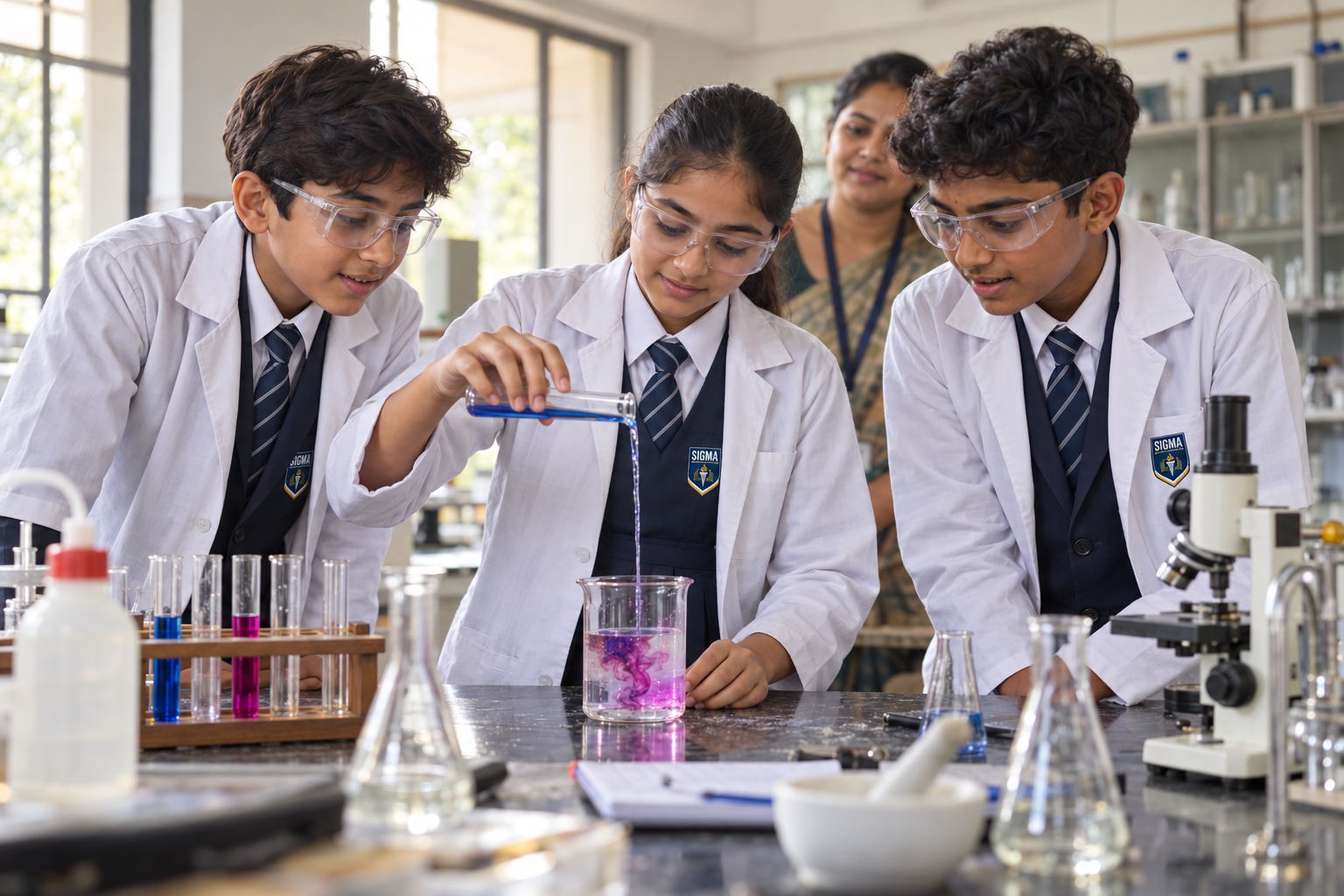
Take a science lesson on why some objects float. Instead of starting with a definition, a class might begin with a tub of water and a pile of objects. Children predict, test and argue about the results. By the time the teacher introduces the scientific idea, they already have a reason to care about it, and real observations to hang it on.
Understanding begins when a child stops asking "Will this be in the test?" and starts asking "Why does this happen?"
Beyond marks: IQ, EQ and SQ
ASTERIA also pays attention to how children grow emotionally and socially. Working in groups, listening to others, handling disagreement and managing frustration are part of the learning, not a distraction from it. We think of this as building capable minds (IQ), emotional awareness (EQ) and responsible social behaviour (SQ) together.
These are the same skills children draw on outside the classroom too, which is why our life skills programme works hand in hand with ASTERIA.
Does this help with exams?
Yes. Children who understand a concept can answer questions they have never seen before, which is exactly what good assessments ask for. ASTERIA sits alongside regular practice, revision and CBSE assessments, not instead of them.
See it in action
The best way to understand ASTERIA is to see a classroom using it. Read more on our Academics overview, or book a campus visit and see it for yourself.